
The Ultimate Guide to the Chakra System
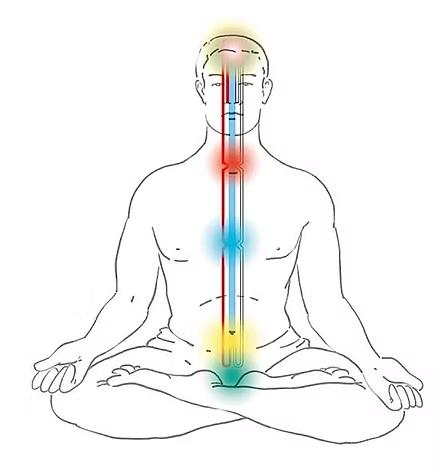
In some of my classes when the subject of the development of intuition within a spiritual practice comes up, I tell a story of when I was giving someone a Reiki/Buddho treatment and upon opening my eyes I could see all seven chakras spinning over the body of my client in the conventionally accepted colours that they are associated with. The question that arises from this experience is, why was I perceiving the chakras in this way, and why was I seeing specifically seven chakras and not some other number? I have no cultural or religious history to inform my understanding or perception of the human energy field. So where did this perception come from? My guess is that it was the product of spending too many years bumming around the New Age where I was picking up spiritual concepts based on the flotsam and jetsam that the New Age throws out after its finished raiding various spiritual traditions for their treasures. Sadly, the commonly known New Age version of the chakra system has very little to do with the original Hindu conception of them. The well-known seven chakra system is so pervasive now that even those who are not even that spiritually inclined, seem to have heard of it. It has developed over the years a fixed set of associations such as certain colours, crystals, attributes, even scents, and the Islamic names of God. It’s not meant to be this way. There are other ways of relating to the bio-field without recourse to thinking about chakras at all but even within the realm of the chakra-orientated, there needs to be a re-assessment of what it is we are actually dealing with here. The commonly understood version of the chakras in the West is based on the concepts of kundalini yoga and was first discussed in a 1919 book called The Serpent Power by the Englishman Arthur Avalon. Avalon’s books contained his own understandings of tantra, kundalini, and the chakras based on his translations of older Hindu texts. It is not very accurate in many of its details. Chakras or ‘channel wheels’ or ‘energy wheels’ as they are sometimes called, have associations with different parts of the body and are the interface between the physical and non-physical aspects of the human anatomy. Chakras play an important role in Tibetan Buddhism as well as in Hinduism. In the Tibetan Buddhist understanding of the chakra system, there are some major differences between the Buddhist and Hindu orientations to them. A Tibetan Buddhist would not commit himself to a static number of chakras as if they are inherently fixed and immutable. In the Tibetan system, depending on the practice you are engaged in, there could be four, five, seven, or ten chakras. Three of these chakras appear in all versions of the system, whilst the others tend to appear only when the practitioner is engaged in higher yogic practices such as Tummo (the practice of generating the inner furnace) or Completion Stage practices (where the subtle winds of the body are brought into the central channel to realise the state of the clear light of bliss and emptiness which ultimately leads to the realisation of enlightenment). The chakras are junction points for the three main energy channels that run along the spine: the central channel and the left and right channels which connect up the 72,000 nadis (streams of energy), allowing for a free flow of vital life-force through them. The classic five-chakra system in Buddhism was explained by HE Zasep Rinpoche whilst discussing the importance of the subtle body in healing practices: “We have crown chakra, we have throat chakra, heart chakra, navel chakra, and secret chakra. Five main chakras. These chakras all have different names. Crown chakra is called the ‘chakra of divine bliss.’ Throat chakra is the ‘chakra of enjoyment.’ Heart chakra is the ‘chakra of Dharma’ — or understanding. Navel chakra is the ‘chakra of manifestation’ or emanation. The secret chakra is the ‘chakra of holding bliss.” The three most important chakras are the crown, throat, and heart which are touched in devotional practices to the Buddha. The secret chakra is mostly limited to practices of Highest Yoga Tantra and the other two (or five, depending on the system) only referenced in very specialised practices. Reginald Ray had this to say in relation to the chakra system: “According to tantra, Enlightenment is fundamentally and originally present in the body. By putting one’s awareness in the body you find that the further down you go the more primordial, unconditioned, and unmanifest is the energy you encounter. The chakras begin at the perineum, which is the most primordial level of awareness, and as you go upwards they are more connected with expression. At the navel there is a sense of the earth, stability, and equanimity; at the heart is a feeling of warmth and compassion; the throat is about communication, expression, and connection; and the head is less a conceptual centre than a place where the energy reaches a crescendo. So the different chakras have very different feels.” The first three chakras are important as they relate to the body, speech, and mind. The crown chakra has a relationship to the body and is associated with activity in the physical world. The throat chakra is related to speech and more subtle activity such as in dreams. The heart chakra relates to the mind, centred on the heart (not the head where the brain sits). Working with the energy of these chakras is not something that is generally taught to outsiders within the Buddhist tradition because of the lack of understanding of their true nature and the inability of most to be able to relate to the chakras in a much more naked way than they would normally be used to. When working with the chakras we are essentially removing the coverings of our energy system to meet that powerful energy in a very direct way. When the ego is stripped
Read More