
Vipassana Vs Samatha Meditation
Vipassana vs Samatha Meditation, which should you be doing? In the original Pali texts of Theravadan Buddhism, Vipassana and Samatha are described as two distinct meditation methods that lead to different qualities of consciousness. But they are not in opposition to each other.
Vipassana means ‘insight’ and is concerned with the development of a clear awareness of what is happening as it happens. Samatha on the other hand, which can be translated as ‘concentration’ or ‘tranquility’ involves bringing the mind to rest as it focuses deeply on one specific thing without wandering. That thing might be the breath, a mantra or prayer, or something visual such as a dot on the wall, a candle flame, a flower, or a religious image. All extraneous thoughts and perceptions are dispensed with as the mind settles into a Samatha practice.
As the practice progresses, the mind enters deeper and deeper levels of concentration. This process spreads an immense feeling of calmness throughout the whole body and mind, leading to tranquility or rapture. Only direct experience reveals the true nature of this state. This temporary feeling lasts until the meditator ends the session.
The Jhanas
These deep levels of direct experience in a Samatha practice are called jhanas and there are eight of them. They are clearly codified and measurable states of consciousness. As you move from one jhana to the next you pass through deeper levels of concentration and the possibility of distraction from the meditative state becomes less and less.
To enter the first jhana, we start with something called access concentration, which is being fully present with the object of the meditation. If you’re focus is on the breath, for instance, you might notice that it becomes very shallow and subtle. This is the access concentration level. What you don’t do when you experience this is take a deep breath! This will simply disturb your meditation and you’ll be back to square one. When your body and consciousness is at rest, the body does not need a lot of oxygen. Leave the breath alone.
When involved in a Samatha practice, it’s critical in the attainment of the jhanas that you should not strive to achieve them. You will fail. All you can do is generate the conditions out of which the jhanas arise. Recognize when you’ve established these conditions, then patiently wait for the jhana to come and find you.
To attain a jhana is no easy task. When it happens, however, it’s a monumental event in your consciousness and you won’t be left wondering if ‘that was it’. It’s very identifiable and will result in a radical shift in the body/mind resulting in the arising of an intense feeling of ecstasy. This feeling of ecstasy is, however, of no practical value to you other than as a marker of having achieved something quite profound on your journey with meditation.
Vipassana
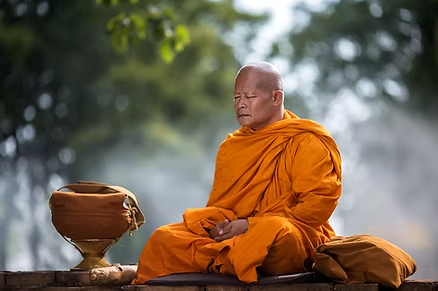
The Buddha invented Vipassana, in part, to address the transitory nature of Samatha’s outcome. It uses the deep levels of concentration that a Samatha practice develops as a tool to chip away at the illusion that clouds an understanding of the true nature of everything.. Vipassana is a slow and gradual process of expanding awareness into the true nature of the manifest universe and everything in it.
The path of Vipassana is not a quick one. There is no instant enlightenment to be had, but enlightenment is the ultimate destination, though it can take many lifetimes to achieve. Once achieved, it’s permanent. There is no going back. A significant difference between Vipassana and Samatha when seen in isolation is that Vipassana certainly does have the potential to lead you to a state of supreme enlightenment, whereas Samatha doesn’t. But keep in mind that Vipassana requires the application of Samatha for it to be truly effective. The two methods have a profound symbiotic relationship.
Vipassana is an ancient and rigorous system of training the mind through a codified set of exercises that allows the practitioner to become more and more aware of their own life experience on all levels.
Are You Paying Attention to Life?
Most people think they are aware of their life and the world around them already, but this is an illusion. Mostly we are paying so little attention to the details of life as it unfolds that we might as well be asleep. We’re not even paying enough attention to realise that we are not paying attention! So, we continue to live in a dream, utterly devoid from the reality all around us.
In a Vipassana practice, we learn to fully experience the sensations of touch and smell, to notice deeply the changes taking place in these experiences. We learn to observe and be present with our own thoughts without jumping into them and seeing the world from their point of view. In a Vipassana practice, we see the truth of the impermanence and selflessness of all phenomena. And we discover deep down how unsatisfactory all of this is.
Two Different Types of Meditation
The notion that we can set up Vipassana in opposition to Samatha is an erroneous one. As I’ve said, there is no Vipassana vs Samatha. Whilst it’s true that the Buddha taught both methods, it’s also true that he never separated them. In all his teachings, the two methods are parts of a single whole. The Buddha made it clear that the purpose of meditation practice is to get the mind to settle and be stable enough that it can perceive things steadily and see them for what they truly are.
If concentration is good, then there is a good foundation on which to build Vipassana. Vipassana is easy but building the concentration that it sits upon is not so easy. Without this concentration, then Vipassana is meaningless.
Through building a laser-like and intensely focused level of concentration, desire simply melts away. Concentration works directly against it, and it is desire that is the source of all our suffering.
Vipassana in the West: Modern Mindfulness
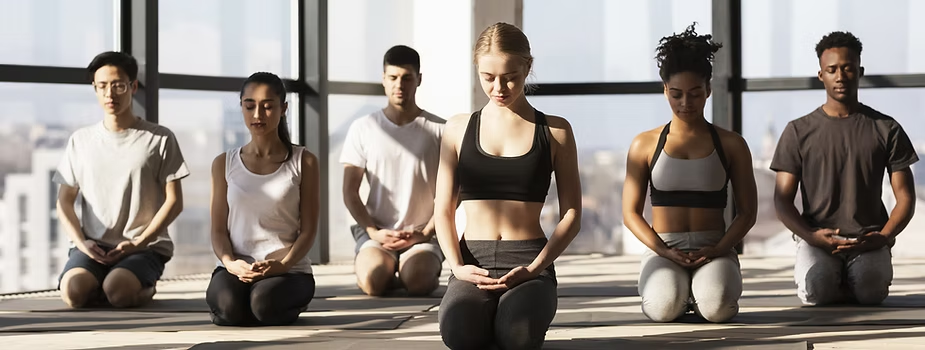
The West uses the word ‘mindfulness’ extensively to describe a version of the Buddha’s Vipassana practice. Jon Kabat-Zinn largely developed this version at the University of Massachusetts Medical Centre in 1979. Kabat-Zinn took the Buddha’s deeply spiritual teaching on meditation, stripped it of its spiritual content and applied it in a therapeutic context in the form of his programme, called ‘Mindfulness-Based Stress Reduction’.
Over the years, practitioners have adapted the MBSR model numerous times to facilitate therapeutic benefits in a variety of contexts. It works successfully alongside cognitive therapy as Mindfulness-Based Cognitive Therapy; it helps people overcome addiction and assists athletes in achieving their potential. Pain management programmes apply it, and companies worldwide use it to reduce work-related stress, improve productivity, and increase employee focus. It even links to everyday activities such as cooking, flower arranging, walking, and the making of art. Mindfulness is becoming deeply embedded in the strata of Western culture and it’s now big business.
Modern Mindfulness: Detached from the Buddha’s Message
However, modern mindfulness completely detaches itself from the Buddha’s teachings and the path that leads the practitioner to a true, permanent liberation from suffering. There is nothing wrong with the Western approach as the changes to the practice have made it more accessible to the Western mindset, but if underpinned with a strong basis of Samatha practice, the whole essence of mindfulness or Vipassana becomes richer, more meaningful, and certainly more powerful in its impact on the day-to-day experience of those who engage with it. Samatha is sadly, not at all emphasised in modern Western mindfulness. No one talks about it and most contemporary mindfulness practitioners have probably never heard of it.
Western mindfulness is very much limited to the therapeutic outcomes of the practice with no real possibility of engaging with its true potential.
Whether this will change remains to be seen. Modern mindfulness is in its infancy and evolving all the time. There is certainly a growing desire, by more and more practitioners to explore its full potential, as they discover mindfulness’ deep spiritual roots. To do that properly, we must give attention to the role of Samatha and its meaning for a full engagement with the practice. Only then can Vipassana fully flower within Western societies.
Time will tell.
